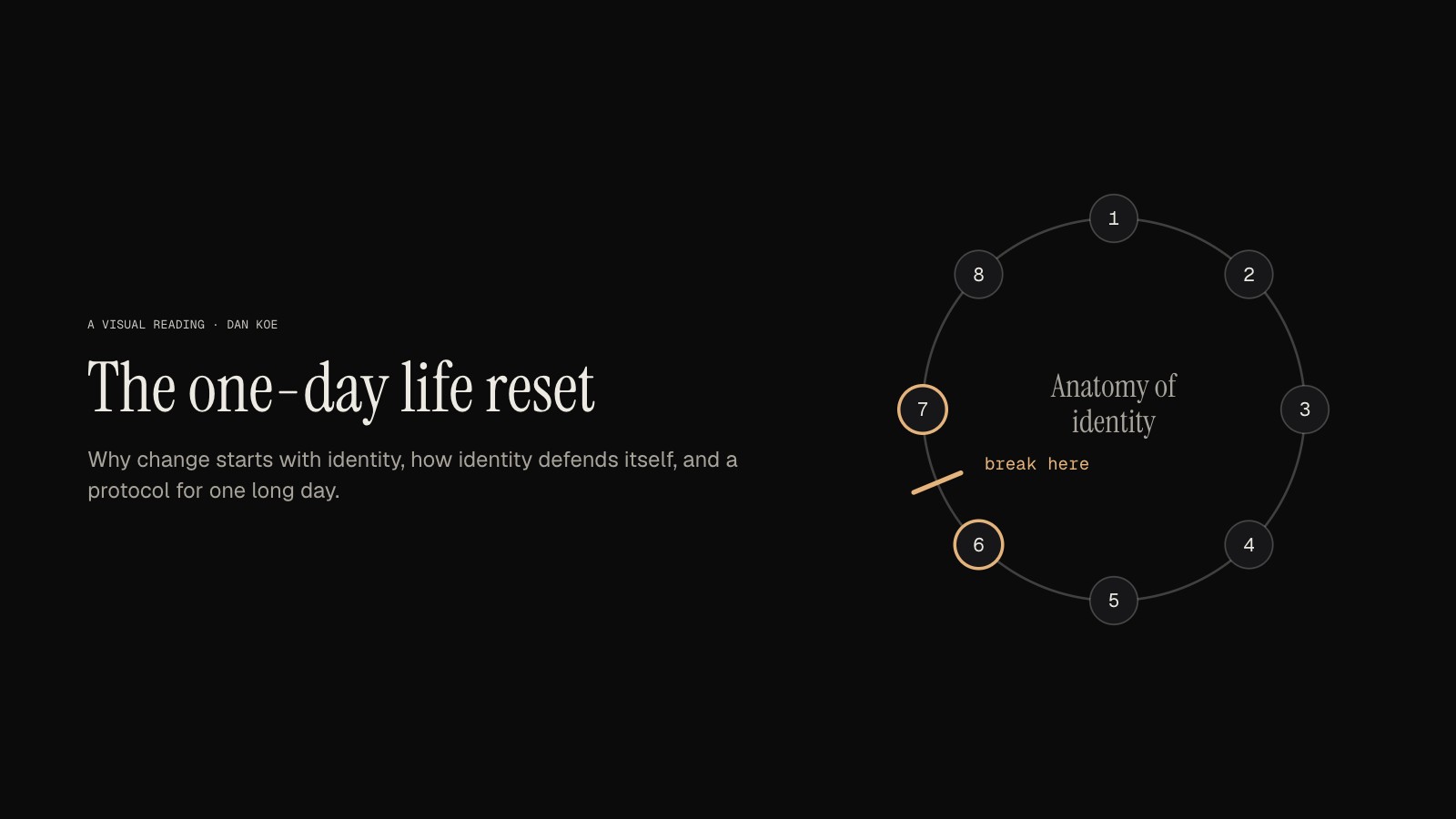
The instructions for the Designing Your Life GPT I built include this question: "If someone observed only your behavior and ignored your words, what would they conclude you truly want?" Dan Koe's letter How to fix your entire life in 1 day, published in January 2026, asks a near-identical one: imagine someone who saw only what you do, never what you say, and ask what they'd decide you're after.
The rest of the letter argues that most attempts to change fail because they work on behavior instead of identity, and it builds to a protocol of self-questioning that takes a full day. From that shared question, his method and the one behind my GPT head in different directions, and I'll come back to that at the end.
I've paraphrased his main ideas and redrawn them, with credit to the thinkers he draws on. The original has the full argument and every one of his questions.
Identity before behavior
Koe splits change into two parts. Changing your actions is second order. Changing who you are, so the actions follow without effort, is first order. Most resolutions, he argues, change actions and leave identity alone, which is why they tend to hold for the first few weeks and then slide.
Take his bodybuilder, who doesn't "grind" to eat well, because eating badly is what would take effort. The lesson Koe draws is that you need the lifestyle that produces an outcome well before the outcome arrives.
Every behavior serves a goal
Next comes teleology: all behavior aims at something, and most of those aims are unconscious. Procrastinating may protect you from the judgment that comes with finishing and sharing work. Staying in a dead-end job may be a pursuit of safety and predictability. The section opens with Alfred Adler: "Trust only movement. Life happens at the level of events, not of words."
So in Koe's framing, real change means changing goals. A goal, as he describes it, is a lens that decides what you notice.
How identity defends itself
This is the part of the letter about why change is hard to keep. A goal hardens into an identity through a loop, and the identity then resists change. Maxwell Maltz introduces the section, comparing an accepted belief to a hypnotist's suggestion.
- You want a goal
- You see reality through it
- You notice what serves it (learning)
- You act and get feedback
- You repeat it until it is automatic (conditioning)
- It becomes who you are: “I am the type of person who…”
- You defend that identity
- The identity sets new goals, and the loop restarts
Once a behavior becomes part of who you think you are, a challenge to it feels like a threat to survival, and you get the same fight-or-flight response, aimed at ideas. Koe traces the pattern back to childhood, when adopting your parents' beliefs was how you stayed safe.
Stages of mind
From there the letter turns to developmental psychology. Koe cites Maslow's hierarchy, Cook-Greuter's stages of ego development, Spiral Dynamics and Integral Theory, which he's combined into his own Human 3.0 model, and summarizes nine stages.
- 1ImpulsiveImpulse and action are the same thing
- 2Self-ProtectiveThe world is unsafe, so look out for yourself
- 3ConformistThe group’s rules feel like reality
- 4Self-AwareYour inner life stops matching the outside
- 5ConscientiousYour own principles, and you hold yourself to them
- 6IndividualistYou see your principles were shaped by context
- 7StrategistYou work within systems while seeing your part in them
- 8Construct-AwareEvery framework, identity included, is a useful fiction
- 9UnitiveThe line between self and life dissolves
Whichever stage you're at, he says, moving through them follows a pattern.
Intelligence as steering
The line on intelligence is borrowed from Naval Ravikant: the real test is whether you get what you want out of life. Koe treats intelligence as one ingredient of success, alongside agency and opportunity, and makes it concrete with cybernetics, from the Greek for "good at steering". Set a goal, act, sense where you are, compare, and act again.
On that definition, low intelligence means quitting at the first roadblock, and high intelligence means iterating until the problem gives way. He admits this isn't the usual definition.
The one-day protocol
People who change their identity, Koe has noticed, tend to go through three phases, dissonance, uncertainty and discovery, and the change often comes quickly once tension has built up. The protocol is meant to bring on the first, carry you through the second and reach the third in a single day, which he suggests repeating every year. You'll need pen and paper, and for the morning questions he says plainly: "Do not attempt to outsource this contemplation to AI."
Morning
Excavation15 to 30 minutes, pen and paper, no AI- Name the low-grade dissatisfaction you have learned to tolerate.
- If nothing changes, describe an ordinary weekday five years from now, then ten.
- Write the identity statement that would make the life you want feel natural.
During the day
Interrupting autopilotQuestions set as phone reminders at scattered times- What is this activity helping me avoid?
- Judging only by the last two hours, what do I seem to want?
Evening
SynthesisTurn the day’s insight into direction- Name the internal pattern that kept you stuck.
- Compress the anti-vision and the vision into one sentence each.
Then three lenses
- One year One concrete sign the old pattern is broken
- One month What keeps the one-year lens possible
- Tomorrow Two or three actions to timeblock
He also says he can't guarantee it will work for everyone. It depends on whether you're at a point in your own story where the questions can land.
Turning it into a game
The letter ends by gathering everything into six components on one page. Mihaly Csikszentmihalyi's description of flow as order in consciousness opens the section, and Koe argues that games are the clearest example of the focus he wants to recreate.
Constraints The rules: what you will not sacrifice, limits that push creativity
Anti-vision What is at stake if you lose
Vision How you win, until the game evolves
One-year goal The mission
One-month project The boss fight: skills to learn, things to build
Daily levers The quests
How it compares with Designing Your Life
The two methods share that question about behavior, and then use it differently. Koe puts the work into one intense day. You make the current life feel unacceptable, write an identity statement, and set goals for the year, the month and tomorrow. My GPT asks the question as one probe among several, and the method behind it ends with prototypes: small, reversible experiments, like a conversation to have or a one-day version of a life to try, whose results can change your mind.
Koe's warning against outsourcing the contemplation to AI applies to my GPT too, and I think he's right that the answers have to be yours. I find the anti-vision exercise useful for surfacing what you've been tolerating. I trust the one-day format less. A day of introspection gives you a hypothesis about who you want to become, and a prototype is how I'd test it. Which brings me back to the shared question: watching your own behavior is how you find the gap in the first place, and it's also how you'll find out whether the new identity has taken hold.
Source and credits
The article is How to fix your entire life in 1 day, by Dan Koe, published on 12 January 2026. The ideas he draws on, all credited in his letter, come from Alfred Adler, Maxwell Maltz, the stages of ego development (Susanne Cook-Greuter, whom Koe cites as "Greuter's"), Maslow's hierarchy, Spiral Dynamics, Integral Theory, Naval Ravikant, cybernetics and Mihaly Csikszentmihalyi.
The diagrams, the wording and any mistakes on this page are mine. The original is the source of truth.